

Since Windows 10 support ended on October 14, 2025, many companies have faced a decision they cannot postpone forever anyway: buying new computers. And at exactly this moment, a new device class is pushing into the market. AI PCs for SMBs promise local artificial intelligence right inside the device, thanks to specialized processing units called NPUs. But is the premium really worth it for the mid-market, or is it mostly marketing?
As so often, the answer lies in the details. Anyone who has to refresh hardware in 2026 anyway should understand the development so as not to have to invest again in two years. This article puts the key terms in context - from TOPS and Copilot+ to the question of which tasks an NPU actually accelerates in everyday work.
What technically makes an AI PC
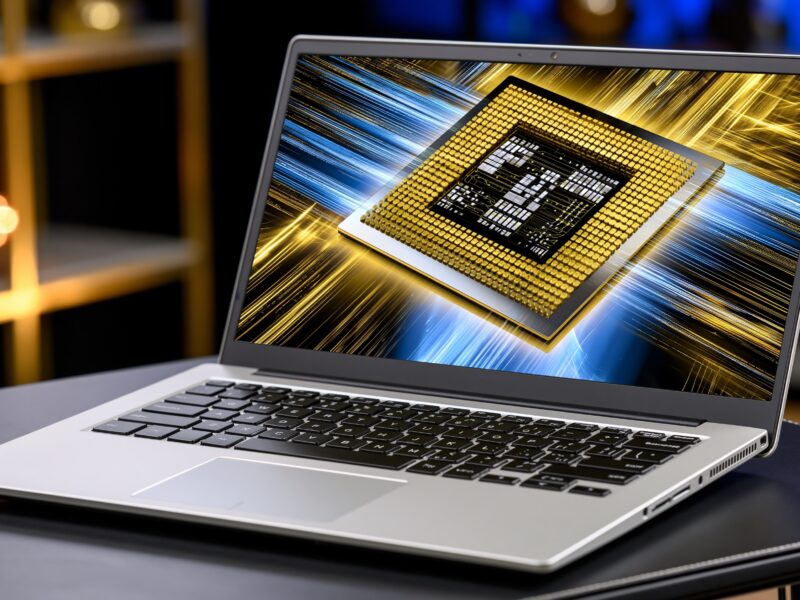
The heart of an AI PC is the NPU, the neural processing unit. It is a chip specialized in AI computations that works alongside the processor (CPU) and the graphics unit (GPU). Its advantage: it handles AI tasks very energy-efficiently, without putting much strain on the main processor and the battery. Its performance is measured in TOPS - trillions of operations per second.
The industry standard for 2026 is an NPU with at least 40 TOPS. Only above this threshold may a device carry Microsoft's Copilot+ label. The current chip generation is in some cases well above it:
- Intel Panther Lake (NPU 5): up to 50 TOPS, market launch in early 2026
- AMD Ryzen AI 400: up to around 60 TOPS with long battery life
- Qualcomm Snapdragon X2: around 80 TOPS, designed for parallel AI tasks
- Intel Nova Lake (desktop): NPU 6 with up to 74 TOPS for stationary workstations
The practical benefit of AI PCs for SMBs
What matters is not the number on the spec sheet but the added value in everyday work. The NPU plays to its strength where AI functions are meant to run locally and continuously in the background. Typical examples from the office:
- live captions and real-time translation in video calls, even without an internet connection
- professional camera correction and background filters in meetings (Studio Effects)
- faster local search across documents and files
- less battery drain, because AI tasks do not burden the main processor
The big advantage for the mid-market is data protection: if the AI runs locally on the NPU, sensitive content never leaves the device. For law firms, medical practices or engineering offices in particular, that is a weighty argument compared with cloud-based services. The question of which country data is processed in disappears, and the functions are available even without a stable internet connection - for example at a customer's site or while traveling.
Still, one should stay honest: not every workstation benefits equally. Anyone who mostly works with word processing, spreadsheets, email and a typical industry application will notice little of an NPU in daily use at first. The hardware unfolds its real value where AI runs regularly in the background. The honest question before any purchase is therefore not which chip is the fastest, but which AI functions your team actually uses every day.
Build 2026: Microsoft opens up the AI functions
Decision-makers should know an important piece of news from spring 2026: at its Build developer conference, Microsoft announced that local AI functions will no longer be restricted exclusively to Copilot+ devices with an NPU. Through improvements to the DirectML runtime, AI tasks are set to run on the graphics unit (GPU) of a broader range of Windows hardware in the future.
For SMBs this means: the pressure to buy the most expensive NPU devices right away is easing. An NPU remains clearly advantageous for continuous, battery-friendly background AI - but it is no longer a must for every AI function. That noticeably defuses the investment decision.
Windows 10, ESU and the cost question
Anyone still on Windows 10 has three options: upgrade compatible devices to Windows 11, buy new hardware, or book the paid Extended Security Updates (ESU) as a bridge. For companies, ESU costs around 61 US dollars per device in the first year - and doubles every year thereafter. Security updates can be extended this way until October 2028 at most, and there are no new features. Anyone who wants to book ESU only in the second year has to pay for the first year retroactively as well.
Scale that up across a larger device fleet and several years, and it quickly becomes clear: ESU is a bridge, not a strategy. The costs rise year after year while the devices grow older and slower and receive no new features at all. ESU mainly makes sense for individual special-purpose machines that are tied to specific legacy software and cannot be migrated at short notice. For the majority of workstations, a planned move to Windows 11 - whether by updating compatible devices or through new purchases - is the smarter choice economically.
What to look for when purchasing
- Devices with an NPU of at least 40 TOPS are future-proof in case AI becomes important in daily work.
- Plan for at least 16 GB of RAM - local AI is memory-hungry.
- Do not replace the whole fleet at once: test with a pilot group, validate, then roll out in stages.
- Use ESU only as a short-term bridge, not as a permanent strategy.
Conclusion
AI PCs are not hype, but they are not a must for every workstation either. Anyone who has to refresh anyway because of the end of Windows 10 is future-proof with an NPU device from 40 TOPS upward - especially where data protection and mobile work matter. Those who only handle standard office tasks, on the other hand, can do well with solid standard hardware thanks to the broader Windows support. What matters is procurement that fits the actual need.
Unsure which device class suits your team and how to make the move to Windows 11 go smoothly? Cryon plans the right hardware strategy for SMBs in Leipzig - from pilot project and financing to a smooth rollout. That way you invest exactly where it pays off. Arrange a no-obligation consultation.
Planning new hardware for your team?
We advise vendor-neutrally, procure and set everything up, so your devices fit the work and not the other way around.